

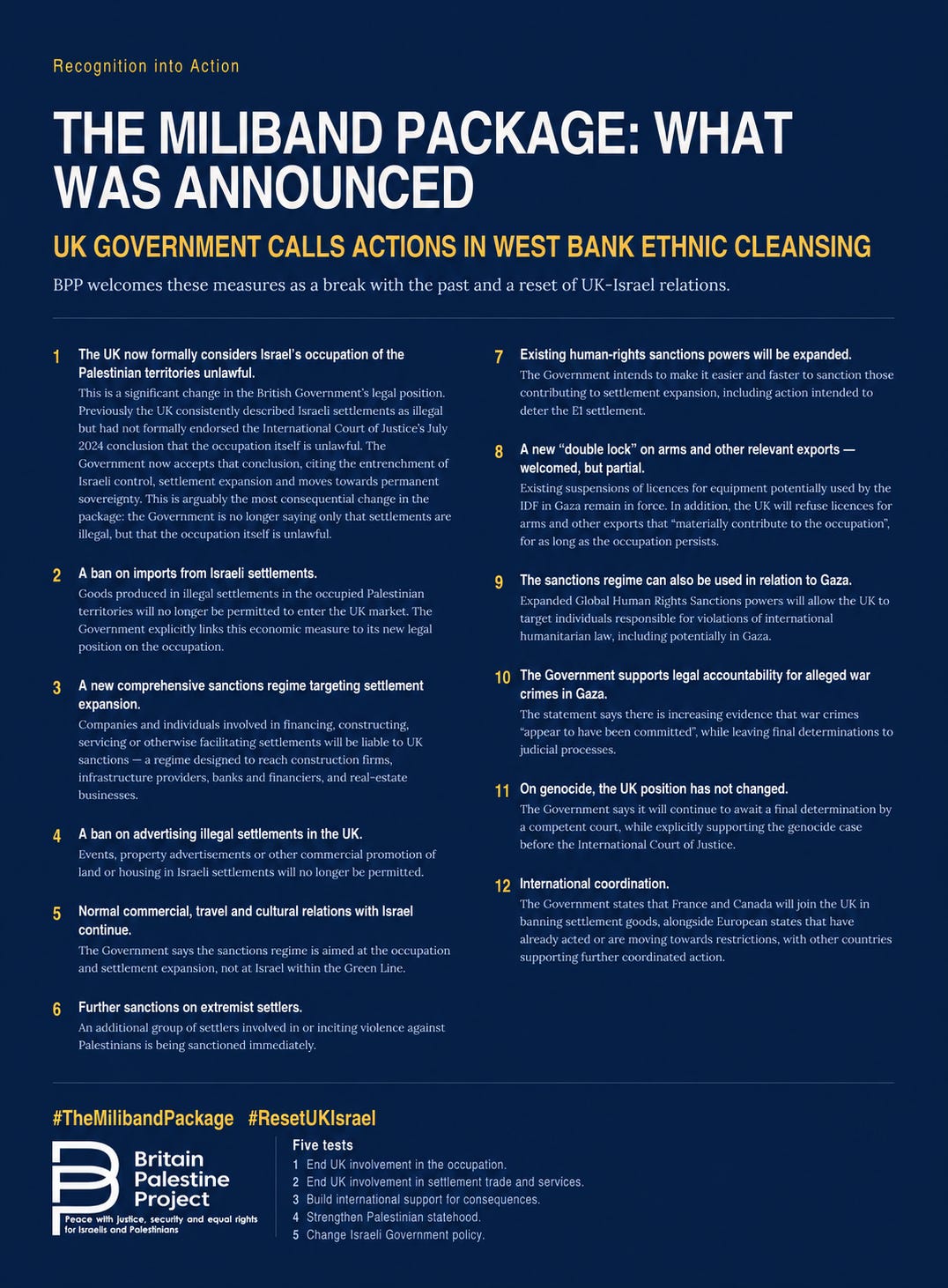
The Britain Palestine Project has welcomed Foreign Secretary Ed Miliband’s statement to Parliament on 8 September and the package of measures announced by the UK Government.
BPP exists to raise awareness of the United Kingdom’s historic responsibility for Palestine and Israel, which originates in the Mandate period, and to examine what that history requires of British policy today. Miliband’s speech was a powerful acknowledgement that the UK bears a particular responsibility here, and a direct role to play in changing the conditions that have allowed occupation, settlement expansion and Palestinian dispossession to continue.
Speaking as a “proud British Jew”, Miliband linked his own family history — including the sanctuary Israel gave his grandmother after the Holocaust — to his support for the rights of Israelis and Palestinians alike. His affirmation of Israel’s right to exist was matched by an equally clear insistence on Palestinian freedom, security and self-determination. This was an important rejection of the claim that support for Israel requires silence about the conduct of its government. As Miliband put it, the UK’s argument is not with the people of Israel but with the policies and actions of the Israeli Government. He was right, too, to insist that holding Jewish communities responsible for those actions is antisemitic, and that holding a government to account for its actions is not.
The speech connected that personal history to the obligations of the state. It recognised that the UK cannot go on professing support for two states while sustaining economic relationships that help entrench an occupation and a settlement system deliberately designed to make a viable Palestinian state impossible.
The public was already there
For the better part of two decades, anyone arguing that Britain should stop trading with illegal Israeli settlements has been told the same thing in the same tone of weary realism. It is well-intentioned but naive. It is legally complicated. It is commercially disruptive. And, above all, it is politically impossible: the British public has no appetite for it, the argument runs, and a government that tried would find itself isolated, accused of singling out one state, and punished at the ballot box.
That argument is now empirically dead.
New Opinium research for the European Council on Foreign Relations, conducted among 2,050 UK adults between 2 and 4 September and published to coincide with the statement, finds that 46 per cent of Britons support a ban on trade in goods with illegal Israeli settlements in the West Bank, including East Jerusalem. Eighteen per cent oppose it. Among those who express a view, the split is 72 to 28 — better than two to one. The rest, a substantial third of the sample, say they do not know, which is what one would expect on a question of trade policy in occupied territory that has never been put to them by a mainstream political party.
It is worth being precise about the shape of that support, because it is unusually broad. Conservative and Reform voters are more likely to support a ban than oppose it. Supporters outnumber opponents among Leave voters as well as Remain voters. They outnumber opponents in every English region, and in Scotland, Wales and Northern Ireland. Across every political, regional, age and gender group reported in the survey, support exceeds opposition. There is no constituency in Britain, on any of the cleavages that usually organise our politics, where a majority of those with an opinion want the UK to keep trading with the settlements.
And on the charge that has done more than any other to suppress this debate: only 16 per cent of Britons think it is antisemitic to single out Israeli settlements for a trade ban. Eighty-four per cent either disagree or do not think so. The public, it turns out, is entirely capable of holding the distinction that the International Court of Justice drew in July 2024, and that the UK and the EU have already applied, quietly and partially, to the tariff treatment of settlement goods for years: a distinction between the State of Israel and the territory it occupies unlawfully.
The Miliband package is therefore not a radical departure. It is a government catching up the public, and a party leadership catching up with its membership.
What the public wants is not rupture for its own sake
It would be a mistake to read these numbers as an appetite for confrontation. They are close to the opposite. The same polling finds that a two-state outcome remains by far the most popular destination among the British public: 40 per cent favour a Palestinian state alongside Israel, against 12 per cent for a single shared state and 8 per cent who prefer the current arrangement of Israel without a viable Palestinian neighbour.
Put the two findings together and the picture is coherent, and rather moderate. The British public wants two states. It can see that settlement expansion is destroying the territorial basis on which two states could exist. It concludes that Britain should stop underwriting the thing that is destroying the outcome it wants. That is not an extreme position. It is not even a particularly political one. It is the ordinary reasoning of people who have noticed that you cannot support a Palestinian state on Monday and buy goods produced by its dismantling on Tuesday.
Leadership despite political risk
None of this made the announcement of the Miliband Package risk-free. The measures were taken in the face of considerable political opposition. Before the statement, the US Ambassador to Israel, Mike Huckabee, warned of American repercussions, and particular attention was drawn to legislation in Florida and other US states that might be used against companies complying with restrictions directed at Israel or the settlements.
No immediate substantial US retaliation has yet been announced. Secretary of State Rubio’s response was notably mild, and the White House stated that Huckabee was not speaking for the President. Trump has been silent. Whether those state laws can or will reach UK businesses is untested. But the threats formed part of the political context in which Miliband and the Government acted. Their judgment was evidently that the legal and moral imperative to act outweighed the potential economic and diplomatic costs.
The UK has now taken a position of real leadership among the G7 states and within the wider coalition supporting the New York Declaration, the restoration of effective UN-led multilateralism and the protection of Palestinian self-determination. France and Canada have said that they will introduce national restrictions of their own. Their detailed measures are not yet published, and whether they will match the scope of the UK package remains to be seen. Other states who signed have not been clear about what they will do precisely.
Why the measures matter
The significance of the package lies not only in its individual components but in the legal and political analysis underpinning them.
First, the Government has formally accepted that Israel’s continuing occupation of Palestinian territory is unlawful, bringing the UK’s official position into line with the ICJ’s advisory opinion of July 2024. The UK has long held that Israeli settlements are illegal, but until now it had remained silent on the lawfulness of the occupation as a whole. Miliband ended that ambiguity: the Government now accepts that the occupation is unlawful by virtue of Israel’s entrenchment of control, its intention to exercise permanent sovereignty and its expansionist settlement programme. This is arguably the most consequential change in the package.
Second, the Government accepted that ethnic cleansing is taking place in parts of the occupied West Bank. Miliband identified settler terrorists as the direct perpetrators, while acknowledging that the Israeli Government has too often turned a blind eye — and that members of it have actively supported the forced displacement of Palestinians.
Third, he recognised the growing evidence that war crimes have been committed in Gaza. On the allegation of genocide he maintained the Government’s position that a final determination is for a competent court. Crucially, however, he went on to say that South Africa’s case was rightly brought before the ICJ, and to affirm the UK’s support for the Court in reaching its determination. The Government also restated its commitment to international legal accountability.
Together, these positions mark a profound change in both the language and the substance of UK policy.
From legal recognition to economic consequence
The Government has accepted an essential principle: if the occupation is unlawful, that unlawfulness must be reflected in the economic relationships the UK chooses to maintain with the occupied territory. The announced package will:
prohibit imports of goods produced in illegal Israeli settlements;
create new powers to sanction individuals and companies that support, facilitate or profit from settlement expansion, including through construction, infrastructure, finance and real estate;
prohibit the advertising or promotion in the UK of land and property situated in illegal settlements;
extend the Global Human Rights Sanctions regime to allow faster action against settlement expansion and serious violations of international humanitarian law, including in Gaza, and to deter the E1 project specifically;
impose immediate sanctions on further extremist settlers who have supported or incited violence against Palestinian communities; and
refuse applications for arms and other export licences where the exports would materially contribute to the occupation.
The measures distinguish settlements from Israel itself. The regime is aimed at the occupation and at settlement expansion, not at Israel within the Green Line, and normal UK trade with Israel is intended to continue.
The existing suspension of more than thirty arms export licences connected to Israeli military operations in Gaza remains in place. The “double lock” Miliband announced means that exports materially contributing to the occupation will stay prohibited for as long as the occupation persists. Work remains to be done, particularly on the scrutiny of existing exports and dual-use goods. Parliament and civil society must establish whether anything now supplied by UK companies could materially contribute to violations in Gaza or the occupied West Bank.
Precision about implementation also matters. Some individual sanctions take effect immediately, but the principal secondary legislation establishing the new settlement trade and sanctions regime is expected within six to nine months. The Government must hold its momentum, resist attempts to dilute the proposals, and ensure that the final regime carries effective monitoring and enforcement mechanisms. Civil society has an important part to play in supporting implementation, identifying possible evasion, and measuring whether the measures are changing corporate behaviour and conditions on the ground.
The most important realignment since 1967
Taken together, this is the most substantive realignment of UK policy towards Israel and Palestine since Foreign Secretary George Brown’s intervention after the 1967 war. Brown insisted on the fundamental principle later embodied in UN Security Council Resolution 242: war must not be allowed to produce territorial acquisition.
The Miliband package applies that principle to the occupation and settlement economy of today. It recognises that Israel, as the occupying power, cannot lawfully transfer its civilian population into occupied territory; that economic activity sustaining that process must not be encouraged; and that the UK must not be complicit in maintaining it.
This change did not come from nowhere. It rests on sustained pressure within the Labour Party, in Parliament and across civil society: first for UK recognition of the State of Palestine, and then for that recognition to carry practical legal, diplomatic and economic consequences. Recognition had to be a beginning rather than an endpoint. This package is the most substantive attempt to date to put it into action.
The international coalition must now act
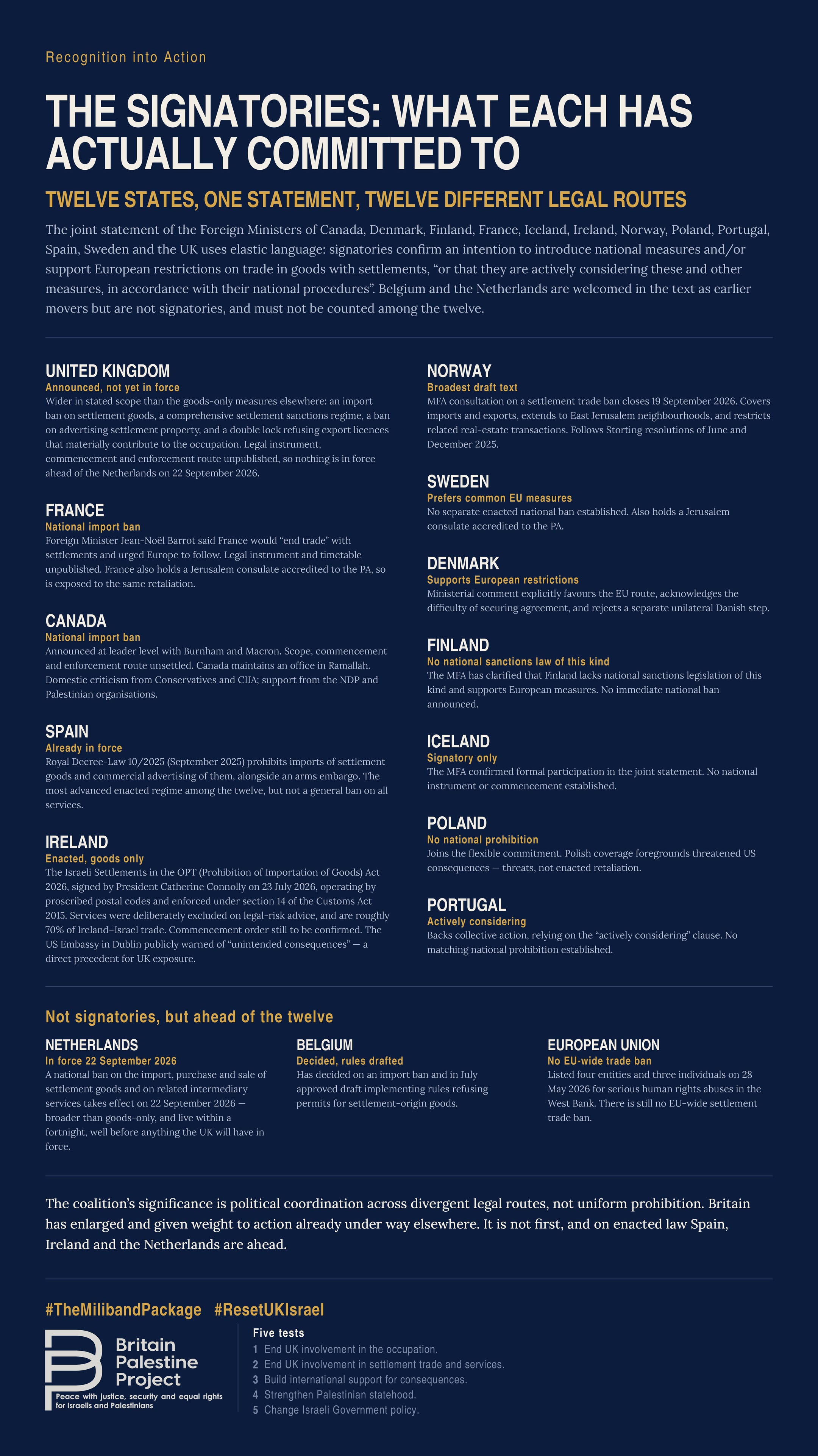
The other eleven signatories of the joint foreign ministers’ statement — Canada, Denmark, Finland, France, Iceland, Ireland, Norway, Poland, Portugal, Spain and Sweden — should turn that shared declaration into effective national measures.
France and Canada have already committed to introducing restrictions. Ireland, Spain, the Netherlands, Norway and Belgium have either acted or begun processes to restrict trade connected to illegal settlements. Denmark, Finland, Iceland, Poland, Portugal and Sweden should now develop equally robust national packages.
European governments should not treat the absence of EU unanimity as a licence for inaction. Where collective agreement remains blocked, states should use their own national legal powers to prohibit settlement goods, address the services and finance sustaining settlement expansion, and prevent companies under their jurisdiction from contributing to unlawful occupation.
The European Union must now catch up. The UK has often aligned itself with EU sanctions regimes; on this occasion, the EU should match the coalition led by the UK, France and Canada and supported by action in Spain, Ireland, Norway, the Netherlands and Belgium. It should introduce an effective prohibition on settlement goods, extend that approach to the services and financial relationships sustaining settlement expansion, and give full effect to the ICJ advisory opinion on the unlawfulness of Israel’s occupation of Palestinian territory.
The UK Government’s measures are directed at illegal settlements, at settlement expansion, and at those responsible for grave violations. They are not directed at the Israeli people. They uphold the principle that Israelis and Palestinians are equally entitled to security, dignity and self-determination.
For all these reasons, the Britain Palestine Project has welcomed Ed Miliband’s words, the clarity and humanity with which he delivered them, and the Labour Government’s decision to act. We will support the effective implementation of these measures, scrutinise the areas where further action is required, and press the wider international coalition to follow the UK’s lead.
This is not the completion of a new policy. It is the beginning of one.